Informational / commercial investigation
How to Start a Food Business Without Overspending
A practical starting framework for validating demand, choosing a workable model, estimating startup cash and avoiding premature spending.
Read guide →Start with demand. Cost what you really produce. Price for profit. Control cash, stock, suppliers and growth with a practical operating playbook.
View on AmazonRead free guides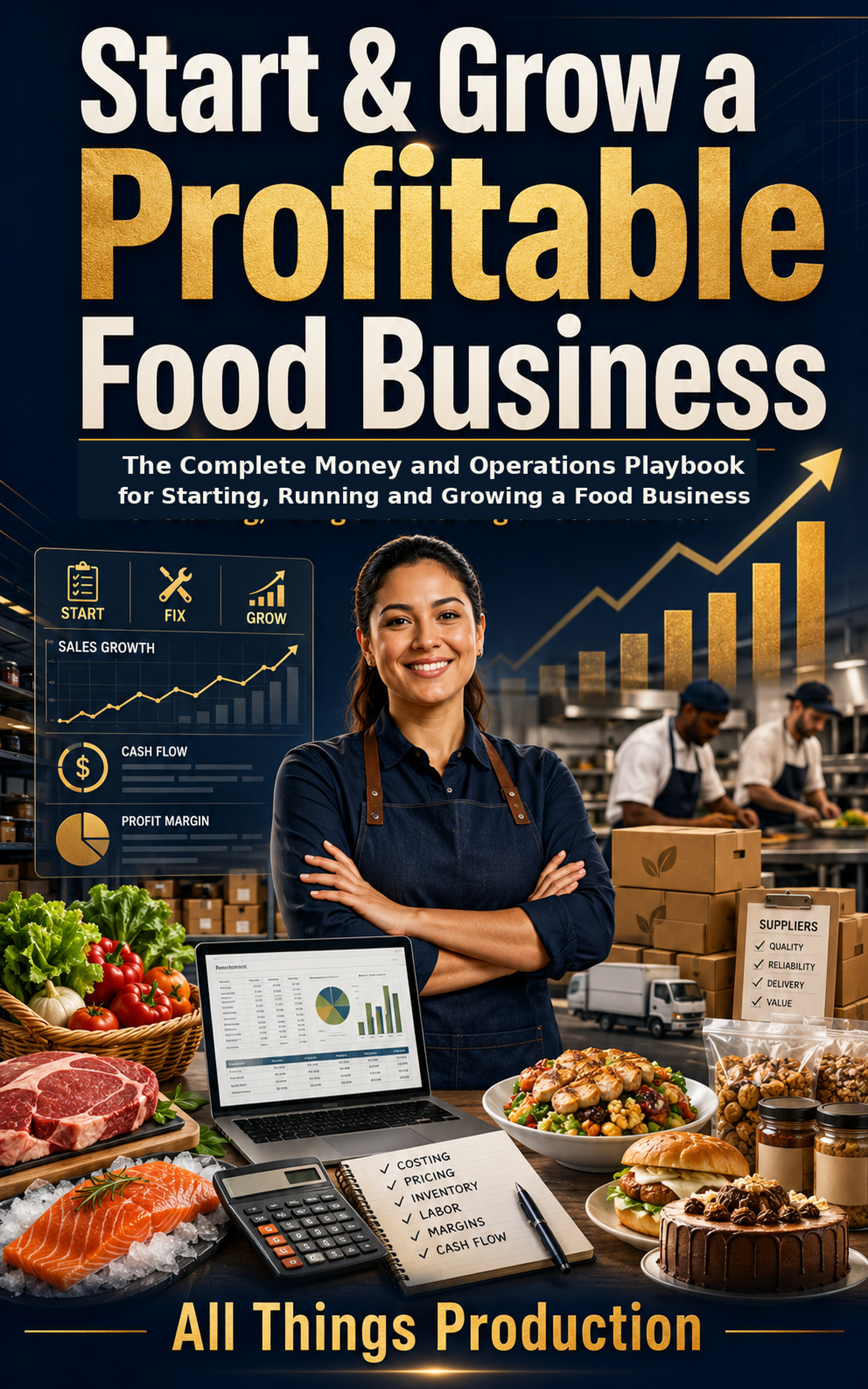
The book connects demand, costing, pricing, cash, inventory, supply chain, waste, channel economics and growth. It is designed as an operating playbook rather than a recipe book.
Choose a food-business model and validate demand before committing serious money.
Build true product cost from ingredients, packaging, labor, yield and channel costs.
Set prices, break-even levels and sales targets from real commercial economics.
Control daily money, working capital, inventory, labor and a 13-week cash forecast.
Manage suppliers, waste, quality, shelf life, traceability, delivery and marketplace fees.
Use model-specific playbooks for home food, restaurant/café, bakery, catering, meal prep, street food, cloud kitchen, fresh produce, meat/fish/poultry, frozen foods, packaged food, processing, wholesale, retail and direct-to-consumer sales.
These public guides explain selected concepts without reproducing the book chapters, spreadsheet library or blank management templates.
A practical starting framework for validating demand, choosing a workable model, estimating startup cash and avoiding premature spending.
Read guide →Learn what belongs in a food product cost, why yield matters and how to set prices using cost, contribution and market reality.
Read guide →Use contribution per unit, fixed costs and a target-profit calculation to turn monthly expenses into a concrete sales requirement.
Read guide →A practical explanation of 13-week cash forecasting for supplier payments, payroll, tax, inventory and early warning of cash shortages.
Read guide →Practical inventory principles for balancing availability, expiry, storage, supplier lead time and working capital in a food business.
Read guide →A business-focused way to measure food waste by reason and money value so improvement effort targets the losses that matter most.
Read guide →The book includes model-specific applications for home food businesses, restaurants and cafés, bakeries, catering, meal prep, street food, cloud kitchens, fresh produce, meat/fish/poultry, frozen foods, packaged food, processing, wholesale, retail and direct-to-consumer operations.
The full chapter sequence, worked operating system, Excel tool library, blank templates, detailed tables and the complete 90-day implementation system are not published on this website.